
Sparq joins Energy Logistics project on battery storage for electrified construction machinery
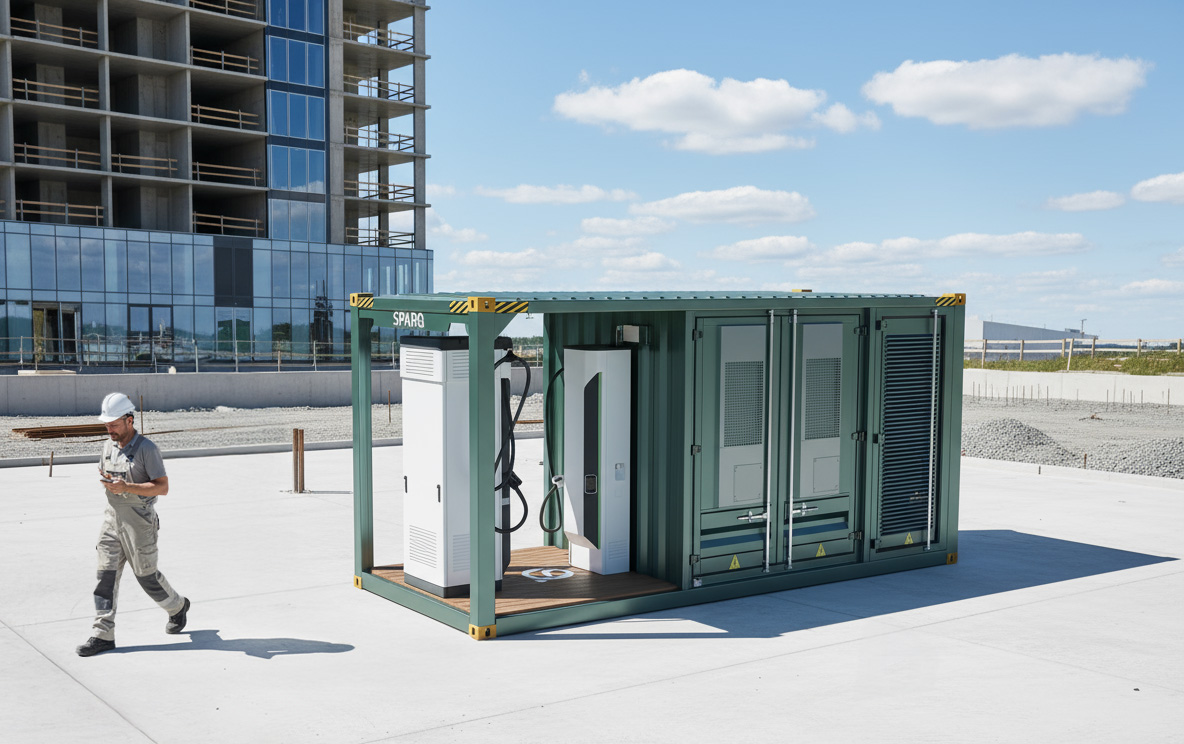
Sparq is taking part in a new project, led by RISE, that explores how battery energy storage systems (BESS) can act as mobile, flexible energy resources to speed up the electrification of construction machinery. The partners are RISE (project leader), Umeå Energi, Umeå kommun, Vera Energy, Norrwatt and Sparq.
Why this matters for electrification
Electric dumpers, wheel loaders and excavators are ready, but the power to charge them often is not. Many construction and civil engineering sites lack an adequate grid connection, especially in early project phases or where the local grid is already heavily loaded.
Today that gap is usually filled by diesel generators, which cancels much of the climate benefit of going electric. Grid reinforcements take time and money, and a construction site only needs the capacity for a limited period.
Solving the charging problem is therefore one of the keys to electrifying the construction sector at scale. It also shows how battery storage can make better use of the grid we already have, instead of waiting for it to be expanded.
The concept: Energy Logistics
The project develops and tests Energy Logistics, where battery systems serve as mobile energy resources that move between uses as needed. Capacity can be placed temporarily on a construction site to charge electric machines. When the batteries are not needed on site, other energy-system actors can use them, for example for flexibility services or backup power.
Business models and pilot cases
The project develops new business models in which the same battery resource creates value in several markets. It analyses three pilot cases:
- Electrified construction sites
- Temporary energy logistics
- Stationary use in the energy system
Sparq's contribution
Sparq brings hands-on experience of designing, installing and operating battery energy storage in Sweden. We develop our BESS designs and energy management system (EMS) in-house, and our installed systems already deliver ancillary services, local-grid flexibility and electric-bus charging, for example in Skövde, Båstad and Helsingborg.
That is the combination Energy Logistics depends on: a battery that charges heavy machinery where grid capacity is short, and earns value in the energy system between assignments. In the project, Sparq contributes expertise in:
- Battery system design and integration – modular, containerised BESS that can be moved and redeployed between sites
- Energy management and control – EMS software that lets one battery switch between machine charging, flexibility services and backup power
- Grid-constrained charging – experience from charging solutions built for sites where the grid connection is the bottleneck
- Flexibility markets – practical knowledge of how batteries earn revenue in the Swedish energy system, which underpins the multi-market business models
Together with RISE, Umeå Energi, Umeå kommun, Vera Energy and Norrwatt, we will test how this works in practice across the three pilot cases.